You are here
Materials About the Federal Rules
The materials listed below, produced or made available by the Center, are related to the Federal Rules of Practice and Procedure (appellate, bankruptcy, civil, criminal, and evidence).
Click here for curated content on Rules of Practice and Procedure.
Displaying 1 - 10 of 247
| Title | Rule(s) |
Date |
|---|---|---|
| USA v. Watts: Order Granting Government’s Unopposed Motion to Appoint Firewall Counsel and Proposed Dates for Rule 16 Disclosure and Evaluation of Defendant SDIL 2017 | Federal Rules of Practice and Procedure, Federal Rules of Criminal Procedure, Fed. R. Crim. P. 16, Fed. R. Crim. P. 12.2 | June 3, 2026 |
| USA v. Zelaya Martinez: Order – Procedures and Schedule EDVA 2020 | Federal Rules of Practice and Procedure, Federal Rules of Criminal Procedure, Fed. R. Crim. P. 12.2 | June 3, 2026 |
| USA v. Watts: Government’s Unopposed Motion to Appoint Firewall Counsel and Proposed Dates for Rule 16 Disclosure and Evaluation of Defendant SDIL 2017 | Federal Rules of Practice and Procedure, Federal Rules of Criminal Procedure, Fed. R. Crim. P. 16, Fed. R. Crim. P. 12.2 | June 3, 2026 |
| USA v. Richardson: Order Establishing Procedures Regarding Mental Health Evidence NDGA 2010 | Federal Rules of Practice and Procedure, Federal Rules of Criminal Procedure, Fed. R. Crim. P. 12.2 | June 3, 2026 |
| USA v. Aquart: 12.2 Order – Appointing Firewall Attorney + Procedures CT 2010 | Federal Rules of Practice and Procedure, Federal Rules of Criminal Procedure, Fed. R. Crim. P. 12.2 | June 1, 2026 |
| USA v. Lujan: Stipulated Order Setting Forth the Conditions Under Which Defendant May Be Examined by the Government’s Mental Health Expert NM 2011 | Federal Rules of Practice and Procedure, Federal Rules of Criminal Procedure, Fed. R. Crim. P. 12.2 | June 1, 2026 |
|
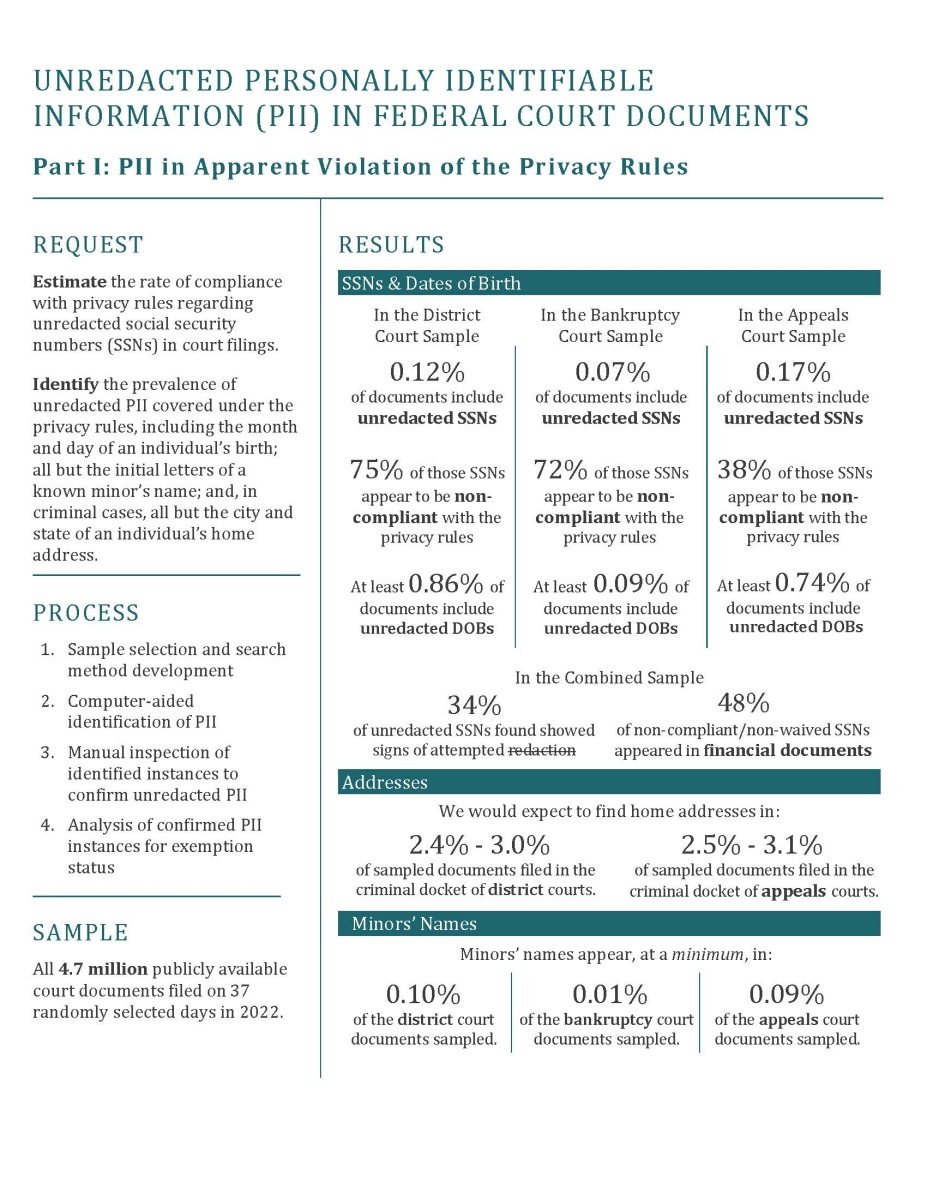
Unredacted Personally Identifiable Information in Federal Court PACER Documents Appellate Rule 25(a)(5), Bankruptcy Rule 9037, Civil Rule 5.2, and Criminal Rule 49.1 require parties and nonparties to redact certain personally identifiable information (PII) in documents they file with the federal courts, including Social Security numbers (SSNs), individual taxpayer identification numbers (ITINs), birthdates, minors’ names, financial account numbers, and, in criminal filings, home addresses.
Following its December 2022 meeting, CACM asked the Federal Judicial Center (Center) to conduct the following research:
Below are links to the Center’s final project report summarizing all research findings, along with previously completed reports and memorandums containing research findings as presented to the committee over the course of the project (see Attachments A-J). Click here for an overview of the Center’s research findings. |
Federal Rules of Practice and Procedure, Federal Rules of Criminal Procedure, Fed. R. Crim. P. 49, Federal Rules of Appellate Procedure, Fed. R. App. P. 26, Federal Rules of Bankruptcy Procedure, Fed. R. Bankr. P. 9037 | May 21, 2026 |
|
Intervention in the Federal Courts of Appeals Prepared for the Advisory Committee on the Federal Rules of Appellate Procedure, this report examines motions to intervene on appeal. Intervention at the beginning of a case is studied in a two-year filing cohort, and intervention at the end of a case, such as after argument or judgment, is examined in a four-year termination cohort. |
Federal Rules of Practice and Procedure, Federal Rules of Appellate Procedure, Fed. R. App. P. 15, Fed. R. App. P. 26.1, Fed. R. App. P. 28.1, Fed. R. App. P. 32 | July 14, 2025 |
|
United States District Courts’ Local Rules and Procedures on Electronic Filing by Self-Represented Litigants This report compiles local rules and procedures in the ninety-four district courts on electronic filing by self-represented litigants. More than two thirds of the courts permit self-represented litigants to use the court’s electronic filing system at least on a case-by-case basis. Twenty-nine courts (31%) generally prohibit electronic filing by self-represented litigants. The Northern District of Texas generally requires it. Ten other courts (11%) generally permit it. The remaining fifty-four courts (57%) permit self-represented litigants to request permission to use the electronic filing system. A 2022 report included a survey of rules and procedures and interviews with court staff in a selection of appellate, district, and bankruptcy courts: Federal Courts’ Electronic Filing by Pro Se Litigants. |
Federal Rules of Practice and Procedure, Federal Rules of Civil Procedure, Fed. R. Civil P. 5 | February 20, 2025 |
|
Default and Default Judgment Practices in the District Courts This report summarizes the actual practices of district courts regarding entry of defaults and default judgments pursuant to Federal Rule of Civil Procedure 55. |
Federal Rules of Practice and Procedure, Federal Rules of Civil Procedure, Fed. R. Civil P. 55 | October 18, 2024 |