You are here
Materials About the Federal Rules
The materials listed below, produced or made available by the Center, are related to the Federal Rules of Practice and Procedure (appellate, bankruptcy, civil, criminal, and evidence).
Click here for curated content on Rules of Practice and Procedure.
Displaying 1 - 10 of 241
| Title | Rule(s) |
Date |
|---|---|---|
|
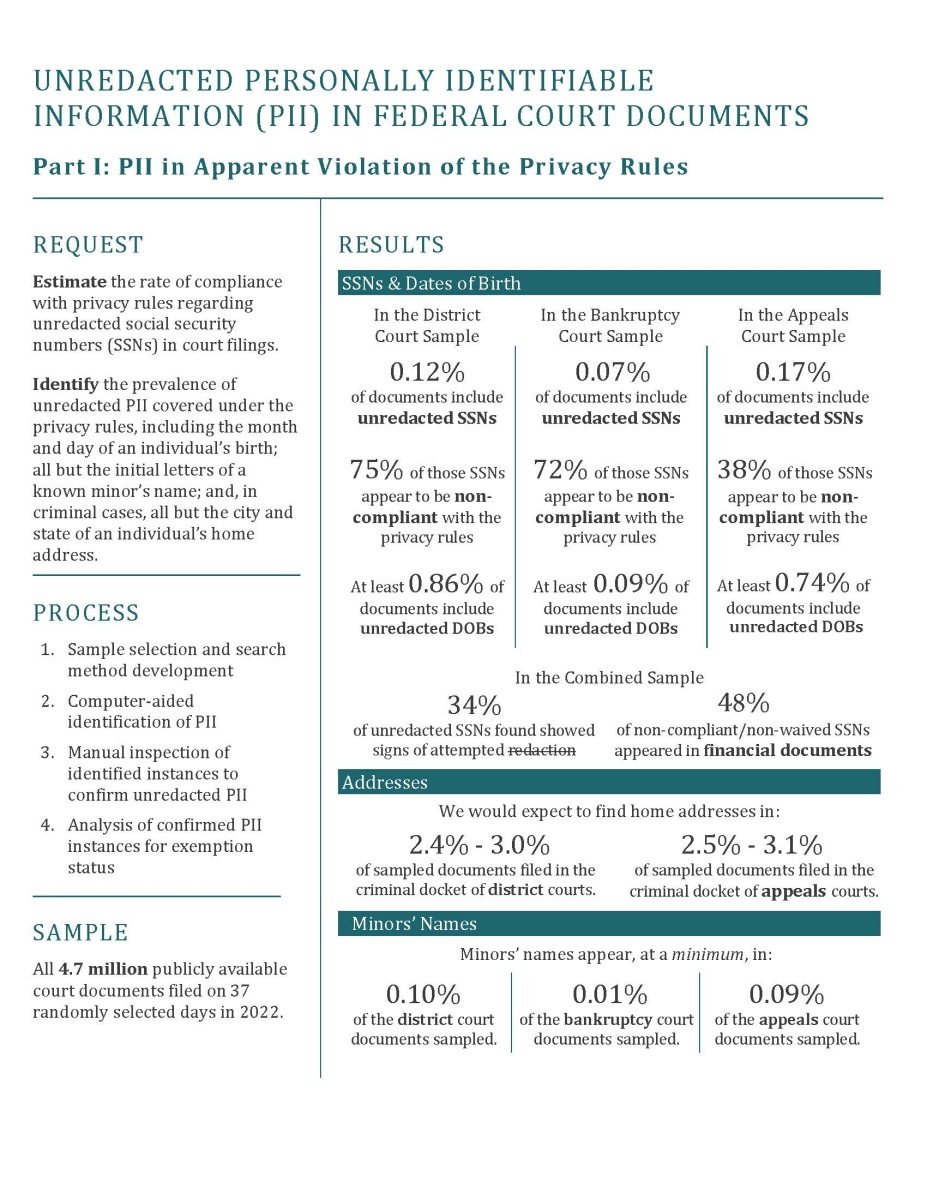
Unredacted Personally Identifiable Information in Federal Court PACER Documents Appellate Rule 25(a)(5), Bankruptcy Rule 9037, Civil Rule 5.2, and Criminal Rule 49.1 require parties and nonparties to redact certain personally identifiable information (PII) in documents they file with the federal courts, including Social Security numbers (SSNs), individual taxpayer identification numbers (ITINs), birthdates, minors’ names, financial account numbers, and, in criminal filings, home addresses.
Following its December 2022 meeting, CACM asked the Federal Judicial Center (Center) to conduct the following research:
Below are links to the Center’s final project report summarizing all research findings, along with previously completed reports and memorandums containing research findings as presented to the committee over the course of the project (see Attachments A-J). Click here for an overview of the Center’s research findings. |
Federal Rules of Practice and Procedure, Federal Rules of Criminal Procedure, Fed. R. Crim. P. 49, Federal Rules of Appellate Procedure, Fed. R. App. P. 26, Federal Rules of Bankruptcy Procedure, Fed. R. Bankr. P. 9037 | May 21, 2026 |
|
Intervention in the Federal Courts of Appeals Prepared for the Advisory Committee on the Federal Rules of Appellate Procedure, this report examines motions to intervene on appeal. Intervention at the beginning of a case is studied in a two-year filing cohort, and intervention at the end of a case, such as after argument or judgment, is examined in a four-year termination cohort. |
Federal Rules of Practice and Procedure, Federal Rules of Appellate Procedure, Fed. R. App. P. 15, Fed. R. App. P. 26.1, Fed. R. App. P. 28.1, Fed. R. App. P. 32 | July 14, 2025 |
|
United States District Courts’ Local Rules and Procedures on Electronic Filing by Self-Represented Litigants This report compiles local rules and procedures in the ninety-four district courts on electronic filing by self-represented litigants. More than two thirds of the courts permit self-represented litigants to use the court’s electronic filing system at least on a case-by-case basis. Twenty-nine courts (31%) generally prohibit electronic filing by self-represented litigants. The Northern District of Texas generally requires it. Ten other courts (11%) generally permit it. The remaining fifty-four courts (57%) permit self-represented litigants to request permission to use the electronic filing system. A 2022 report included a survey of rules and procedures and interviews with court staff in a selection of appellate, district, and bankruptcy courts: Federal Courts’ Electronic Filing by Pro Se Litigants. |
Federal Rules of Practice and Procedure, Federal Rules of Civil Procedure, Fed. R. Civil P. 5 | February 20, 2025 |
|
Default and Default Judgment Practices in the District Courts This report summarizes the actual practices of district courts regarding entry of defaults and default judgments pursuant to Federal Rule of Civil Procedure 55. |
Federal Rules of Practice and Procedure, Federal Rules of Civil Procedure, Fed. R. Civil P. 55 | October 18, 2024 |
|
Local-Counsel Requirements for Practice in Federal District Courts This report, which was prepared for the standing Committee on Rules of Practice and Procedure’s subcommittee on attorney admissions, summarizes when and where federal district courts require local counsel to participate in litigation and attorney admissions to the district courts’ bars. |
Federal Rules of Practice and Procedure | April 24, 2024 |
|
Fees for Admission to Federal Court Bars This report, which was prepared for the standing Committee on Rules of Practice and Procedure’s subcommittee on attorney admissions, summarizes fees charged for admission to federal court bars, including admission fees, pro hac vice fees, and fees charged by state and territory bars for certificates of good standing. |
Federal Rules of Practice and Procedure | March 4, 2024 |
|
Amendments to the Federal Rules of Practice and Procedure 2024—Transmittal to the Supreme Court This package of materials was transmitted to the U.S. Supreme Court on October 23, 2023, concerning amendments to the Federal Rules of Practice and Procedure to become effective on December 1, 2024. This contains proposed amendments to Federal Rules of Appellate Procedure 32, 35, and 40 and appendix on length limits; Federal Rules of Bankruptcy Procedure 1007, 4004, 5009, 7001, and 9006, new rule 8023.1, and all restyled rules; Federal Rule of Civil Procedure 12; and Federal Rules of Evidence 613, 801, 804, and 1006 and new rule 107. Additional information about these amendments is available at Amendments to the Federal Rules of Practice and Procedure (webpage). Information about rules amendments and the rule-making process is available on uscourts.gov at United States Courts Rules & Policies. |
Federal Rules of Practice and Procedure, Federal Rules of Appellate Procedure, Fed. R. App. P. 35, Fed. R. App. P. 40, Fed. R. App. P. 32, Federal Rules of Evidence, Fed. R. Evid. 613, Fed. R. Evid. 804, Fed. R. Evid. 801, Fed. R. Evid. 107, Fed. R. Evid. 1006, Federal Rules of Civil Procedure, Fed. R. Civil P. 12, Federal Rules of Bankruptcy Procedure, Fed. R. Bankr. P. 1007, Fed. R. Bankr. P. 4004, Fed. R. Bankr. P. 5009, Fed. R. Bankr. P. 7001, Fed. R. Bankr. P. 8023, Fed. R. Bankr. P. 8023.1, Fed. R. Bankr. P. 9006 | October 23, 2023 |
|
Amendments to the Federal Rules of Practice and Procedure 2024—Transmittal to the Judicial Conference This package of materials was transmitted to the Judicial Conference, and it includes proposed amendments to the Federal Rules of Practice and Procedure to become effective on December 1, 2024.
Additional information about these amendments is available on the Federal Judicial Center’s website at Amendments to the Federal Rules of Practice and Procedure (webpage). Information about rules amendments and the rule-making process is available on uscourts.gov at United States Courts Rules & Policies. |
Federal Rules of Practice and Procedure, Federal Rules of Appellate Procedure, Fed. R. App. P. 32, Fed. R. App. P. 35, Fed. R. App. P. 40, Federal Rules of Bankruptcy Procedure, Fed. R. Bankr. P. 1007, Fed. R. Bankr. P. 4004, Fed. R. Bankr. P. 5009, Fed. R. Bankr. P. 7001, Fed. R. Bankr. P. 9006, Federal Rules of Civil Procedure, Fed. R. Civil P. 12, Federal Rules of Evidence, Fed. R. Evid. 1006, Fed. R. Evid. 613, Fed. R. Evid. 801, Fed. R. Evid. 804 | August 15, 2023 |
|
Amendments to the Federal Rules of Practice and Procedure 2023—Transmittal to Congress This package of materials was transmitted to Congress on April 24, 2023, concerning amendments to the Federal Rules of Practice and Procedure to become effective on December 1, 2023. Amendments to the Federal Rules of Practice and Procedure are as follows:
Additional information about these amendments is available on the Federal Judicial Center’s website at Amendments to the Federal Rules of Practice and Procedure (webpage). Information about rules amendments and the rule-making process is available on uscourts.gov at United States Courts Rules & Policies. |
Federal Rules of Practice and Procedure, Federal Rules of Appellate Procedure, Fed. R. App. P. 2, Fed. R. App. P. 26, Fed. R. App. P. 4, Fed. R. App. P. 45, Federal Rules of Bankruptcy Procedure, Fed. R. Bankr. P. 3011, Fed. R. Bankr. P. 8003, Fed. R. Bankr. P. 9006, Fed. R. Bankr. P. 9038, Federal Rules of Criminal Procedure, Fed. R. Crim. P. 16, Fed. R. Crim. P. 45, Fed. R. Crim. P. 56, Fed. R. Crim. P. 62, Federal Rules of Evidence, Fed. R. Evid. 106, Fed. R. Evid. 615, Fed. R. Evid. 702 | April 24, 2023 |
|
Electronic Filing in State Courts This report presents the results of an analysis of electronic filing practices in state courts to identify courts that require attorneys to complete electronic filings on the due date before a certain time other than midnight local time. We examined state-court systems in thirty states, chosen to include at least half of the states that comprise each of the eleven federal numbered circuits. An appendix includes rule excerpts. This report supplements a report on Electronic Filing Times in Federal Courts. |
Federal Rules of Practice and Procedure | November 22, 2022 |