
You are here
Penhallow v. Doane's Administrators
Introduction
July 2026 marked the 250th anniversary of the Declaration of Independence. Many Americans think of this as the start point for their system of self-government. But the federal courts—now an essential element of the national government—did not figure significantly in the initial blueprint for it. The Articles of Confederation, passed by Congress in 1777 and ratified by the states in 1781, did not include plans for a federal judicial system, instead leaving the lion’s share of the new nation’s legal work to state courts, some of which predated independence.
A single clause in the Articles anticipated that Congress might create a court for limited purposes in maritime cases. Congress eventually created the Court of Appeals in Cases of Capture in 1780, shortly before each of the thirteen states had ratified the Articles. This court heard appeals in cases deciding the legal status of vessels and cargo seized during the Revolutionary War (ca. 1775-1783). Such cases were common during the war and often carried with them the allocation of potentially vast sums in prize money from the proceeds of captures.
This spotlight examines Penhallow v. Doane’s Administrators (1795), the case that affirmed the validity of this court years after the Constitution of the United States had rendered both the Court of Appeals and the Articles obsolete. In doing so, the Penhallow Court engaged in one of the earliest examinations of the validity of a federal law. The spotlight begins with a brief exploration of the limited role the Articles of Confederation anticipated for the federal government in adjudicating legal cases. It then explains the creation of the Court of Appeals, before detailing the factual and legal background of Penhallow and examining the case’s historical significance.
The Articles of Confederation and the Creation of the First Federal Court
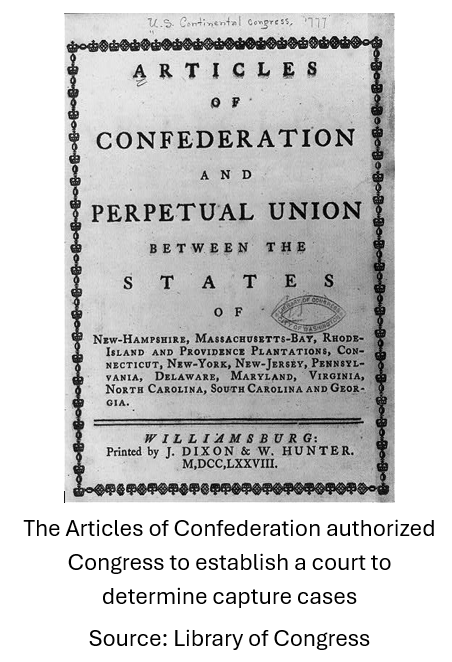
Given that a de facto state of war had begun in the colonies in 1775, it is perhaps unsurprising that prize cases became a national issue even before America had formally declared its independence. General George Washington, the leader of the Continental Army, had called on Congress to establish trial courts to hear capture cases on multiple occasions in 1775 and the first several months of 1776. Though it acted on these requests, Congress did not initially set up any courts of its own. Rather, in November 1775, Congress passed a series of resolutions that authorized the seizure of enemy vessels by privateers and recommended that states either set up their own trial courts to replace the British vice admiralty courts that had previously heard similar disputes or vest existing courts with jurisdiction to hear capture cases. In the run of these cases, privateers would bring captured vessels and their cargo before state admiralty courts, claiming that the capture was lawful and seeking to have the ship and its cargo condemned and sold as a prize for their efforts. Ship owners contesting the legitimacy of the capture (or third parties arguing that they were the lawful captors of the vessel) could dispute the petitioners’ claims. Under the 1775 resolutions, Congress “or such person or persons as they shall appoint” would then hear appeals of these contested cases.
This reliance on state courts, rather than the creation of the federal admiralty courts Washington had suggested, was in keeping with the broader sense of legal continuity between colonial and state legal systems that was a distinctive feature of the American Revolution. It also reflected the relatively limited scope most patriot politicians foresaw for the national government at that early juncture. Congress’s quasi-judicial role in hearing appeals may strike modern Americans unaccustomed to Congress exercising this kind of role as somewhat anomalous. However, the British parliament had had a long history of blending judicial functions with its primary legislative role. By the time of independence, appeals from vice admiralty courts were typically heard by a committee of lords of the privy council, senior members of Parliament who advised the king. Congress likely seemed the closest American analog to this body. Moreover, the Articles, drafted shortly after Congress began hearing appeals, anticipated at least some broader continuity with the tradition of blended judicial and legislative functions. Article IX, for instance, gave Congress the quasi-judicial power to arbitrate border disputes between states.[1]
The first appeal from the state maritime courts arrived at Congress’s door in August, 1776. Congress initially heard appeals using ad hoc committees. In January, 1777, having heard seven appeals with the promise of more generated by the expanding conflict against Britain, lawmakers established a standing committee of five members to hear maritime appeals.[2] While Congress had yet to relinquish control over these appeals by the time it sent the Articles to the states, the framers of the Articles clearly anticipated the possibility that Congress might create a court to relieve it of those duties.[3] Article IX granted Congress the power to appoint special courts “for the trial of piracies and felonies committed on the high seas” and to establish courts “for receiving and determining finally appeals in all cases of captures,” provided that no member of Congress serve on such courts.
Article IX was significant for formally contemplating the potential existence of federal courts for the first time. Even so, the tightly circumscribed subject matter jurisdiction of these hypothetical courts (as opposed to state courts of general jurisdiction) spoke to the limited scope the framers of the Articles foresaw for the national government. Congress was to have significant say in matters maritime and martial, but it was to have a much more restricted role in domestic affairs. Arguably, this distribution of responsibility was confirmed by the placement of the power to create special courts in Article IX, which, in addition to the provision on border disputes, dealt with a range of congressional powers over matters of war and peace and other international concerns like the appointment of ambassadors.
Ratification of the Articles, which unlike the later Constitution required unanimous consent from the states, took roughly four years. During this time, the Second Continental Congress continued to operate as the national government and to hear prize appeals. The committee system it used to do so was not a success, however, partly because many cases never reached Congress and partly because Congress’s powers were limited once it decided an appeal. Some state courts proved reluctant to permit appeals to Congress, lest adverse decisions undermine their authority. Other states placed statutory limitations on appeals, such as the 1776 Massachusetts law that authorized appeals only in cases that involved vessels outfitted by the United Colonies (the original sobriquet for the new nation).
A high-profile 1778 appeal involving the capture of a British vessel first by an American captive aboard the ship and later by a Pennsylvanian naval ship brought Congress’s lack of power to enforce its appellate decisions into sharp relief. The Pennsylvania trial court had initially awarded the bulk of the prize proceeds to Pennsylvania, but Congress overturned this decision on appeal, in favor of the captured seaman. In 1779, a Pennsylvania court simply refused to adhere to Congress’s reversal of its decision on remand. The state court reasoned that Congress did not have the power to reverse a finding of fact made by a jury. Congress opted not to attempt to further enforce its appellate decision, with the Committee on Appeals reasoning that to do so might have consequences “dangerous to the public peace of the United States.” (The underlying dispute, however, continued in various forms for nearly three decades, resulting in the landmark Supreme Court decision United States v. Peters (1809)).
This case, along with complaints from Spain—which had not been permitted leave to appeal to Congress in a Massachusetts case—eventually led Congress to act. In 1780, Congress passed a resolution creating the Court of Appeals in Cases of Capture. The court consisted of three judges, of whom two would constitute a quorum. It was to adhere to the law of nations and could not conduct jury proceedings. (See Court of Appeals in Cases of Capture).
The appellate court relieved congressmen of the burden of hearing appeals and created a more regular judicial structure for doing that work, but it did not remedy a key deficiency of the committee system. In its final form, the law creating the court essentially relied on the goodwill of the states to enforce its decisions.[4] Although an earlier draft of the legislation contained a provision binding state courts to follow and implement the Court of Appeals’s judgments, this language was removed, probably due to concerns about Congress’s powers to legislate over state judicial proceedings. A compromise resolution requesting that states pass laws requiring their courts to follow appellate decisions was also defeated at the same time Congress created the court. This problem aside, there was another potential issue with the court: the Articles of Confederation, which had authorized the creation of such a tribunal, had yet to be ratified. This timing ultimately gave rise to an argument in Penhallow that the establishment of the court itself was beyond Congress’s powers.
Penhallow
 The case that ultimately produced Penhallow began in October, 1777, when a brigantine called the M’Clary captured the Lusanna,[5] a putative British vessel, as a lawful prize off the New Hampshire coast. John Penhallow was one of several New Hampshirites who owned the M’Clary. He and another owner, along with the M’Clary crew’s agent, George Wentworth (hereinafter “the Penhallow litigants”), sued in New Hampshire court to claim the Lusanna and her valuable cargo of whale oil and related supplies. The Lusanna’s owners, Elisha and Isiah Doane and James Shepard (hereinafter “the Doane litigants”), citizens of Massachusetts, put in an opposing claim on the Lusanna. The Doane litigants argued in substance that the ship’s crew had merely been posing as British loyalists to secure safe passage. As such, they argued that the vessel was not properly subject to capture.
Elisha Doane, one of the wealthiest men in New England, was represented in the New Hampshire court by John Adams, by then one of the most renowned patriot lawyers in the new nation. Despite these advantages, Adams rightly worried before trial that local courts might find against his clients. The court held a trial in December, 1777, with the jury finding in favor of the Penhallow litigants. The Doane litigants requested leave to appeal to Congress, but the court denied the request as contrary to state law. The Doane litigants then filed for appeal in the Superior Court of New Hampshire, which eventually upheld the judgment of the trial court in September 1778.[6]
Following the Superior Court’s judgment, the Doane litigants filed an appeal to Congress. Although the New Hampshire courts again denied the attempted appeal, a petition from Elisha Doane was read in Congress in October, 1778. Congress’s Committee on Appeals made an initial finding that it had jurisdiction over the case but appears to have taken no further action before Congress created the Court of Appeals. In September, 1783, that court reversed the New Hampshire courts’ decisions, ruling that the vessel and its cargo had to be returned to the Doane litigants. (Pleadings in subsequent litigation suggest the ship and its cargo had already been sold and the proceeds distributed according to the state courts’ decisions).
The Court of Appeals’s ruling did not end dispute in the case. The state of New Hampshire attempted and failed to have Congress overturn the court’s decision, and the Doane litigants sought to satisfy their judgment through common-law state courts without success.[7] These efforts delayed the case’s resolution past the ratification of the Constitution and creation of the Article III judiciary in 1789.
The Doane litigants[8] then filed a libel (the admiralty equivalent of a complaint) in the U.S. District Court for the District of New Hampshire, which then transferred the case to the U.S. circuit court (then the primary federal trial court) for the same district.[9] The transfer apparently was designed to avoid a potential conflict of interest, as District Judge John Sullivan had represented New Hampshire in an earlier phase of the litigation. The transfer permitted Supreme Court justices to hear the case while riding circuit.
The Penhallow litigants responded to the suit by arguing that the New Hampshire judicial proceedings had been final and that “no other court ever had, or hath, or ever can have power to revoke, reverse and annul” the final decision of the state court. This argument proceeded from the reasoning that Congress did not have authority to institute either the Committee on Appeal or the Court of Appeals in Cases of Capture. As Congress’s own resolutions on prize adjudication had initially suggested, they argued, Congress’s powers with respect to the adjudication of claims were limited to requests that states take legal action; they did not extend to the creation of a new species of national court unless the states had ceded to Congress the authority to take that step.
 Due to the Court’s practice of rotating circuit allotments each term, several justices presided over various preliminary matters in the case. Justice John Blair, Jr., ultimately heard the case alone as Justice James Wilson, the other justice then assigned to New Hampshire, recused himself (Justice Wilson had represented the Doane litigants before the Court of Appeals and in some later state litigation). In October, 1793, Justice Blair entered a ruling on the question of liability in favor of the Doane litigants based on the Court of Appeals’s decision and ordered that the Penhallow litigants pay “their damages and costs, occasioned by their not complying with the decree of the Court of Appeals.” He then appointed commissioners to determine that amount. In October, 1794, the commissioners reported a total to the court, nearly half of which was due to interest accumulated over the long course of the litigation. On October 24, with Justice William Cushing now presiding, the court entered a “definitive sentence” against the Penhallow litigants of $38,518.69 in damages and $154.30 in costs—a significant sum at the time. The Penhallow litigants then appealed to the Supreme Court.
At this phase in the Court’s history, the justices generally gave their opinions seriatim, meaning that each justice separately stated his rationale, rather than the Court speaking through a single opinion. Justice Wilson continued to recuse himself, and Chief Justice John Jay was in England when the Penhallow case came before the Court in February, 1795. The four remaining justices (the minimum number required for a quorum at the time) each issued opinions that, to varying degrees, rejected the Penhallow litigants’ attacks on the legitimacy of the Court of Appeals (although the Court adjusted the award of damages).[10]
 Justice William Paterson began his opinion with a detailed history—adopted by the other justices—of the by-now epic litigation, lamenting the complexity of the past proceedings. Turning to the merits, Justice Paterson noted that jurisdiction in the case turned on the “competency” of the Continental Congress to pass legislation, a question seldom (if ever) litigated before the Court to that point. Though distinct from the question of the Supreme Court’s power to determine the constitutionality of a statute passed by Congress under the auspices of the 1789 Constitution, Penhallow nonetheless presented an important early instance of the Court evaluating the legitimacy of congressional action.[11] Arguably adopting the strongest, most nationalist interpretation of Congress’s powers among the justices, Paterson emphasized that Congress “was the general, supreme, and controuling force of the nation, the centre of the union, the centre of force, and the sun of the political system.” Powers of “war and peace,” he reasoned were “component parts of this supremeacy, and incidental thereto is the question of prize.” As such, he concluded that Congress had an inherent power to establish courts to adjudicate prize cases with or without the ratification of the Articles.
Justice Blair, who had issued the original judgment in the circuit court, agreed with Justice Paterson’s rationale and also concluded that Congress’s power to establish prize courts was an essential element of its sovereign power. And while his opinion on the subject was more cursory, Justice Cushing appears to have been broadly consonant with this line of reasoning.
Justice James Iredell, however, was more guarded on the question of Congress’s authority. Justice Iredell emphasized that Congress’s powers derived from those of the states. If the states had not ceded power over the adjudication of prize cases to the national government, then he seemingly doubted that Congress could create a court exercising such jurisdiction. To the extent Congress had debatable power over prize cases in 1780, when it created the Court of Appeals, however, Iredell reasoned that the ratification of the Articles by the states could be read as an acquiescence in that power by the states. Moreover, he reasoned that the Court of Appeals had already determined that it had the power to hear the case as (what was then) the highest court capable of addressing that issue. Analogizing the Court of Appeals to a foreign admiralty court, whose rulings the federal courts would enforce, he reasoned that it was appropriate for the circuit court to treat that issue as resolved and enforce the award to the Doane litigants.
Aftermath and Legacy
 Perhaps unsurprisingly, given the lengths to which the parties had already gone to sustain the dispute over the Lusanna, the Supreme Court’s decision was not entirely the end of the matter. The state of New Hampshire again complained to Congress, although leading Congressman James Madison gave the petition short shrift on the floor of the House in view of the Court’s decision. The Penhallow litigants initially disregarded an order from the circuit court acting on remand, as well as a subsequent monition warning that they would be imprisoned should they fail to satisfy the court’s decree. In a final act that made clear the difference in authority between the Article III courts and their forebearer Court of Appeals, Justice Cushing ordered arrest warrants to issue for each of the Penhallow litigants, which appears to have at last moved them to pay.[12]
Penhallow’s broader impact was as one of the earliest expressions of the courts’ ability to inquire into the scope and nature of Congressional power. Though none of the justices argued that the Continental Congress had exceeded that authority, they (and both sets of parties) seem to have taken it as read that the federal courts could properly evaluate the validity of the Court of Appeals of Capture a decade and a half after Congress had created it and several years after the Court of Appeals in Cases of Capture had been replaced by the new federal judicial system. Though Chief Justice Marshall did not cite the case in his opinion in Marbury v. Madison (1803), Penhallow therefore formed an important component of the body of ideas that undergirded the view of judicial power announced in Marbury and frequently expounded upon in the centuries since.
[1] The committee system was also analogous to Congress’s mechanism for hearing petitions for monetary claims against the federal government, which lasted until the creation of the Court of Claims in 1855. (See Court of Claims, 1855-1982).
[2] This body was variously referred to as the “Committee on Appeal,” the “commission of appeal, “court of commissioners”, and, most confusingly, “court of appeal.” In the interests of clarity, this spotlight uses the first of these terms.
[3] A 1775 draft of the articles drawn up by Benjamin Franklin had made no mention of capture cases, but the version that was introduced to Congress in July 1776, after Congress had initiated the capture appeals scheme, included language about the potential creation of the court.
[4] The Peters Court adopted a much firmer line on states’ obligations several years after much of the jurisdiction of the Court of Appeals in Cases of Capture was assumed by Article III federal courts in 1789). See United States v. Peters, 9 U.S. 115 (1809).
[5] The U.S. Reports and several secondary sources use the name “Susanna,” but it appears from John Adams’ papers and other contemporaneous sources that the ship was named “Lusanna.” See “Adams’ Minutes of the Trial: New Hampshire Court Maritime, Portsmouth, 16 December 1777,” Founders Online, National Archives, https://founders.archives.gov/documents/Adams/05-02-02-0009-0001-0003.
[6] An early Superior Court proceeding had resulted in a hung jury.
[7] A Pennsylvania state court found in 1787, for example, that it had no power to attach maritime property that had by then been relocated to the commonwealth. See Doane’s Administrators v. Penhallow, 1 U.S. 218 (Phila. Ct. Com. Pl. 1787).
[8] It appears that Elisha Doane died during the initial appellate litigation (although his death was not recorded by the Court of Appeals) and the administrators of his estate were later substituted as litigants. The Penhallow litigants subsequently claimed that his death made the Court of Appeals’s order essentially impossible to follow. The Supreme Court ultimately ruled that Doane’s death did not affect the case because the proceedings were in rem (that is, directed at the property in question rather than any person or persons). See Penhallow, 3 U.S., at 86 (Paterson, J.).
[9] At this time, U.S. district courts generally had jurisdiction over maritime prize cases. See Glass v. The Sloop Betsy, 3 U.S. 6 (1794).
[10] The Court reduced the total amount of the award by calculating interest from the date of the 1783 Court of Appeals decision, rather than from 1778. Justice Iredell took the position that Wentworth should be relieved of liability as he acted in reliance on the state court’s ruling in selling the Lusanna and its cargo and dispersing the funds. However, the other three justices reasoned that Wentworth was aware of the pending appeal to Congress at the time he acted in this way and should thus be individually liable for half of the total amount. This differed from the original decree, which had made all the Penhallow litigants jointly liable for the total amount (thereby allowing the Doane litigants to seek the full amount from the, presumably wealthier, Penhallow litigants). Somewhat unusually, this was effectively an admission of error in their own actions in the court below from Justices Blair and Cushing.
[11] The Continental Congresses assembled in 1774 and 1775 were effectively provisional, revolutionary bodies who derived their legitimacy from that of the Revolution, rather than from legal compacts like the Articles or the Constitution. Nonetheless, at least some of the justices seem to have assumed some level of continuity-of-authority between those bodies and the constitutionally established Congress of their own time.
[12] Wentworth may not have paid his full debt to the Doane litigants. Moreover, an English insurance company subsequently sued Doane’s estate to recover some funds it had previously paid out for the loss of the Lusanna and its cargo. The success of this litigation is unclear. See Maeva Marcus, ed., The Documentary History of the Supreme Court of the United States, 1789-1800, vol. 6 (New York: Columbia University Press, 1998), 396.
Winston Bowman, Associate Historian
For more information, contact history@fjc.gov
Related FJC Resources:
Jurisdiction: Admiralty and Maritime
The Court of Appeals in Cases of Capture (1780-1789)
Further Reading:
Gerber, Scott Douglas, ed., Seriatim: The Supreme Court before John Marshall. New York: New York University Press, 1998.
Goebel, Julius, Jr., The Oliver Wendell Holmes Devise: History of the Supreme Court of the United States, Vol. I, Antecedents and Beginnings to 1801. New York: MacMillan, 1971.
Jameson, J. Franklin. “The Predecessor of the Supreme Court.” In Essays in the Constitutional History of the United States in the Formative Period, 1775–1789, edited by J. Franklin Jameson. Boston: Houghton, Mifflin and Co., 1889.
Marcus, Maeva. Documentary History of the Supreme Court of the United States, 1789–1800, Vol. 6. New York: Columbia University Press, 1998.
Mas, Deirdre and Paul MacMahon. “The Revolutionary Prize Cases and the Origins of Diversity Jurisdiction,” Buffalo Law Review, vol. 63 (2015): 477–547.
This Federal Judicial Center publication was undertaken in furtherance of the Center’s statutory mission to “conduct, coordinate, and encourage programs relating to the history of the judicial branch of the United States government.” While the Center regards the content as responsible and valuable, these materials do not reflect policy or recommendations of the Board of the Federal Judicial Center.