
You are here
Early Radio in the Federal Courts
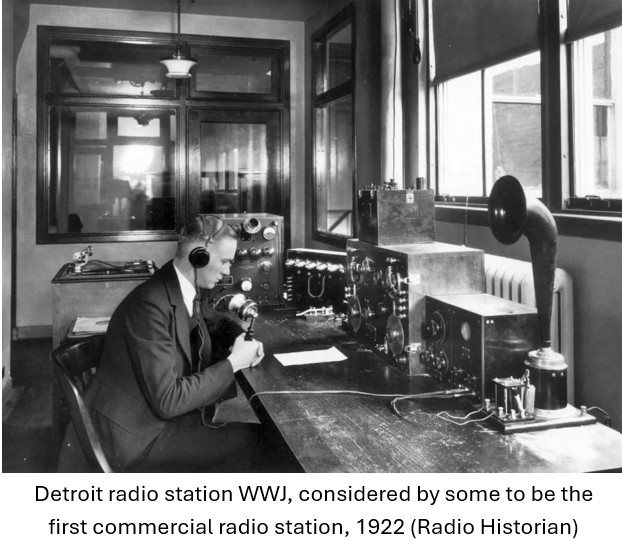
On the evening of November 2, 1920, Pittsburgh radio station KDKA came on the air to broadcast the results of that day’s national elections, which it received by telephone from the Pittsburgh Post newspaper. The few who owned receiving sets and lived within the approximately 300-mile broadcast radius may have been unaware of the significance of what they heard that night. Wireless broadcasting of the human voice, as opposed to the dots and dashes of Morse code, had been possible since 1906 but was at first limited to the military and amateur radio operators. Because KDKA was established by the Westinghouse Electric & Manufacturing Company, its election night transmission is widely considered the first commercial radio broadcast despite containing no advertisements.[1]
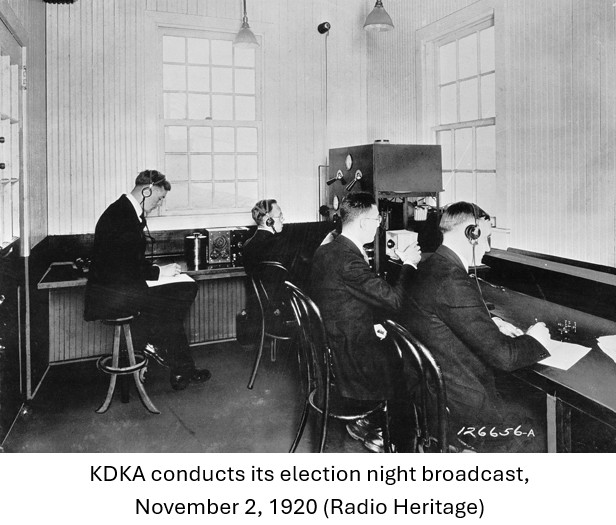
Westinghouse’s demonstration of radio’s potential played a significant role in kicking off the radio boom of the 1920s, during which the technology swept the nation, becoming a highly profitable and enormously popular commercial enterprise. The early days of commercial radio, spanning the 1920s to the 1940s, demonstrate a pattern that has repeated throughout American history. When a new social, cultural, or technological phenomenon emerges—and radio was all these—it eventually finds its way into the courts.
By the early 1930s, legal commentators were employing a new term: “radio law.” As explained in the first edition of the short-lived Journal of Radio Law (1931–1932), the term stood for two things. First was the body of administrative law focusing on “how radio facilities shall be allocated” and “how their use shall be regulated.” This area of law was driven by the twin realities that radio frequencies were a finite resource and that radio broadcasts had the potential to interfere with one another. Second was the “slightly misleading” use of “radio law” to suggest the existence of “a new and separate branch of jurisprudence.” In fact, most of what was called radio law was not entirely new but instead involved the application of existing principles of law to new factual circumstances arising from radio broadcasting. “The advent of radio … has introduced new problems in a number of established branches of law among which may be mentioned copyright, patents, trusts and monopolies, defamation, nuisance, unfair competition, and many others.”
This spotlight covers both aspects of radio law in its early decades. It begins with an overview of the role the federal courts played in the federal regulatory process and concludes with illustrative examples of federal court cases adapting established legal principles to situations involving radio.
In its earliest years, commercial radio was scantily regulated by the federal government. An act of 1912 made it a misdemeanor to operate any apparatus for the transmission of radio signals without a license from the secretary of commerce.[2] The statute had been passed with radio telegraphy in mind and eventually proved to be utterly inadequate for the new world of voice and music broadcasting, primarily because the power it vested in the secretary of commerce was insufficient to permit the rejection of unworthy applications. In 1923, the Court of Appeals of the District of Columbia[3] ruled in Hoover v. Intercity Radio Co. that the secretary was required to issue a license to anyone meeting the statutory requirements.
Three years later, the U.S. District Court for the Northern District of Illinois held in U.S. v. Zenith Radio Corp. that the secretary had no regulatory discretion under the statute and therefore no authority to impose specific conditions on licensees beyond the general ones explicitly provided by Congress. Soon afterwards, U.S. Attorney General William Donovan issued an opinion coming to the same conclusion. The consequence was chaos on the airwaves in the form of widespread interference, as commercial broadcasters were free to ignore any provisions in their licenses crafted by the secretary of commerce regarding broadcast frequencies, transmission power, and hours of operation.
Congress redressed the situation with the Radio Act of 1927, establishing the Federal Radio Commission (FRC). The FRC was empowered to issue radio broadcasting licenses of up to three years in duration and could regulate, among other things, frequency or wavelength assignments, broadcasting power limits, and hours of operation. When deciding whether to grant a construction permit, station license, or renewal or modification of an existing license, the FRC was to consider whether “public interest, convenience, or necessity would be served by the granting thereof.” Section 16 of the Act provided that FRC decisions denying applications for construction permits, station licenses, or renewals or modifications of existing station licenses could be appealed to the Court of Appeals of the District of Columbia.
The Radio Act was written in a way that gave the appeals court broad discretion in reviewing FRC decisions, allowing the court to take additional evidence and providing that it could “alter or revise the decision appealed from and enter such judgment as to it may seem just.” This grant of power quickly caused complications, however. In FRC v. General Electric (1930), the Supreme Court ruled that it lacked jurisdiction to hear an appeal in a radio case on the grounds that the proceeding before the court of appeals was in essence administrative and not judicial. Section 16 of the 1927 Act, said the Court, allowed the appeals court to function as “a superior and revising agency in the same field” as the FRC.
In response to the General Electric decision, Congress amended the Radio Act in 1930 by limiting appeals court review of FRC decisions to issues of law and establishing FRC findings of fact as conclusive if “supported by substantial evidence” and not clearly “arbitrary or capricious.” The revised appeal provision specifically provided for Supreme Court review on writ of certiorari. The Supreme Court found these revisions valid in FRC v. Nelson Brothers Bond & Mortgage Co. (1933). Congress carried the same provision over, with only minor changes, to the Communications Act of 1934, which replaced the FRC with the Federal Communications Commission (FCC).[4]
In keeping with the revised standard set forth in the 1930 amendment, court review of FRC decisions was highly deferential for most of the 1930s. In 1938, one radio expert described the chances of a successful appeal as “infinitesimal,” noting that the court of appeals had set aside the FRC’s findings only once in the previous seven years. Beginning in the late 1930s, however, some observers noted that the court’s attitude toward the FCC had recently begun to shift, citing Heitmeyer v. FCC (1937) and Saginaw Broadcasting Co. v. FCC (1938) as evidence. In Heitmeyer, the court found the FCC’s denial of a station license based on a lack of financial qualification to be arbitrary and capricious. In doing so, the court of appeals conducted a searching inquiry of the FCC’s factual findings, concluding that many of them were unsupported by the record, speculative, or overly general and conclusory. In particular, the court noted that the FCC had failed to articulate a clear standard for financial responsibility that the applicant did not meet. The ruling was viewed as a departure from previous cases in which the court of appeals had accepted FCC findings without a comparably close analysis.
The court emphasized the importance of detailed factual findings again in Saginaw, cautioning the FCC against basing its decisions on overly general statements. As stated in the opinion, “a reviewing court cannot properly exercise its function upon findings of ultimate fact alone, but must require also findings of the basic facts which represent the determination of the administrative body as to the meaning of the evidence, and from which the ultimate facts flow.” Saginaw was an appeal from the FCC’s denial of a construction permit for a radio station. The appeals court characterized the ultimate fact as a finding that granting the permit would or would not serve “the public interest, convenience, or necessity” as the Communications Act required. A basic or supporting factual finding in this context, the court explained, would be the likelihood that a new station would create electrical interference with existing stations in the area, taking into account such factors as wavelength and broadcasting power.
Based on Heitmeyer, Saginaw, and similar cases, one law professor announced the arrival in 1939 of a “new era in radio appeals” with two key features. First, he asserted, “the appellate court now examines with a more critical eye the findings and conclusions of the [FCC].” Second, “the court now requires the [FCC] to demonstrate factually that its standards … consist of firmer stuff than mere declarations in the words of the statute, backed up by vague generalities or no findings resting on the record.”
The increased vigilance of the court of appeals was at times tempered by Supreme Court reversals, especially when the lower court attempted to impose procedural requirements on the FCC. In FCC v. Pottsville Broadcasting Co. (1940), for example, the court of appeals reversed the denial of a radio license on the grounds that the FCC had made an error of law. On remand, the FCC scheduled a hearing to evaluate the application in question on a comparative basis with two others. The court insisted that the FCC reevaluate the petitioner’s application on its own and on the record as it then existed, without regard to other applicants. The Supreme Court reversed, ruling that when the court of appeals corrected a legal error, it “exhausted the only power which Congress gave it.” Beyond that, it was for the FCC, and not the courts, to decide how best to determine what was in the public interest.
FCC v. WOKO, Inc. (1946) shows the Supreme Court again finding the court of appeals had exceeded its authority. There, the appeals court reversed the FCC’s denial of a license renewal based on false statements made by the applicant. The court found the FCC’s action arbitrary and capricious because the agency had not determined that the false statements were material or had influenced its past decisions. The Supreme Court reversed, holding that the FCC was entitled to deny the application even if the concealed facts were immaterial, because it could consider the fact of the concealment to be more significant. Acknowledging the difficulty of the case, the Court concluded, “it is the [FCC], not the Courts, which must be satisfied that the public interest will be served by renewing the license. And the fact that we might not have made the same determination on the same facts does not warrant a substitution of judicial for administrative discretion since Congress has confided the problem to the latter.”
The Supreme Court also demonstrated its determination to protect the FCC’s discretion when it decided National Broadcasting Co. v. United States in 1943. There, the Court recognized for the first time the commission’s authority to issue regulations affecting broadcasting companies. In 1941, the FCC issued an extensive set of regulations on “chain broadcasting,” defined in the 1934 Act as the “simultaneous broadcasting of an identical program by two or more connected stations.” The impetus for the regulations was the increasing consolidation of commercial radio in the United States. At the end of 1938, 341 of the 660 commercial radio stations in the country were affiliated with one of the three national networks (NBC, CBS, and the Mutual Broadcasting System). National network stations used 97% of the nighttime broadcasting power nationwide, with NBC and CBS together controlling more than 85%.[5]
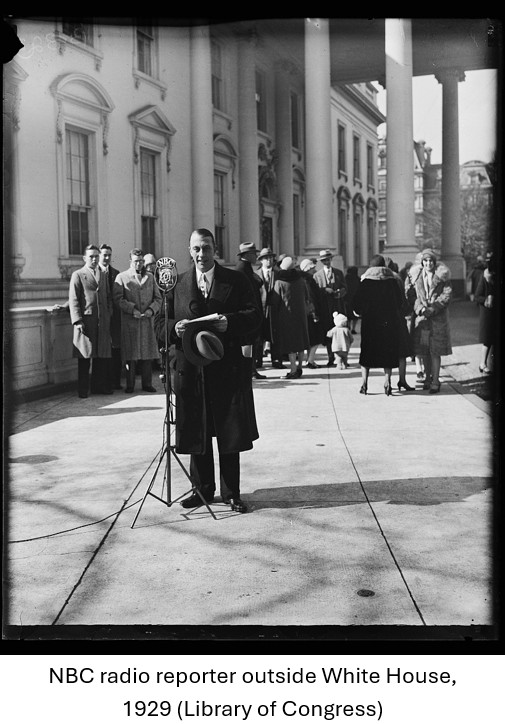
The chain broadcasting regulations prohibited the granting or renewing of licenses for stations having certain contractual relationships with the national networks. The new rules were intended to prevent monopolization of the airwaves, permit growth and competition in the radio industry, and allow listeners access to a wider variety of programs. For example, the FCC found contract provisions preventing network-affiliated stations from broadcasting the programs of any other network to be against the public interest. In support of its point, the agency cited the 1939 World Series, to which Mutual had purchased the broadcast rights. When Mutual offered the games to stations affiliated with NBC and CBS, those stations were forced to decline because of the exclusivity clauses in their contracts. As a result, many listeners across the country were unable to hear the games.
Among other things, the FCC set a two-year maximum duration for an affiliation agreement between a station and a network, gave stations more latitude to reject network programs they did not wish to carry, and placed limits on network ownership of stations. Both NBC and CBS sued in the U.S. District Court for the Southern District of New York, claiming that the FCC had vastly exceeded its regulatory authority under the Communications Act. A three-judge panel in the district court granted the government’s motions for summary judgment and dismissed both suits, whereupon the networks appealed directly to the Supreme Court, as permitted by the 1934 Act. Deciding both cases in a single opinion, the Court affirmed the judgments below, upholding the chain broadcasting regulations.
In reaching its holding, the Court took note of the fact that Congress had vested the FCC with broad authority to see that radio was used in the public interest, and that the 1934 Act had specifically given the agency authority to regulate chain broadcasting. To the networks’ claim that the regulations were arbitrary and capricious, the Court responded, “If this contention means that the Regulations are unwise … we can say only that the [networks] have selected the wrong forum for such a plea.” The Court also rejected the networks’ contention that the regulations had violated their First Amendment rights. Radio was a limited resource, not available to all, making government regulation essential, and the FCC’s choice to refuse licenses to stations engaging in certain network practices was within its remit of advancing the public interest. By recognizing the FCC’s extensive regulatory authority over the networks, the NBC case was a significant event in the commission’s development.
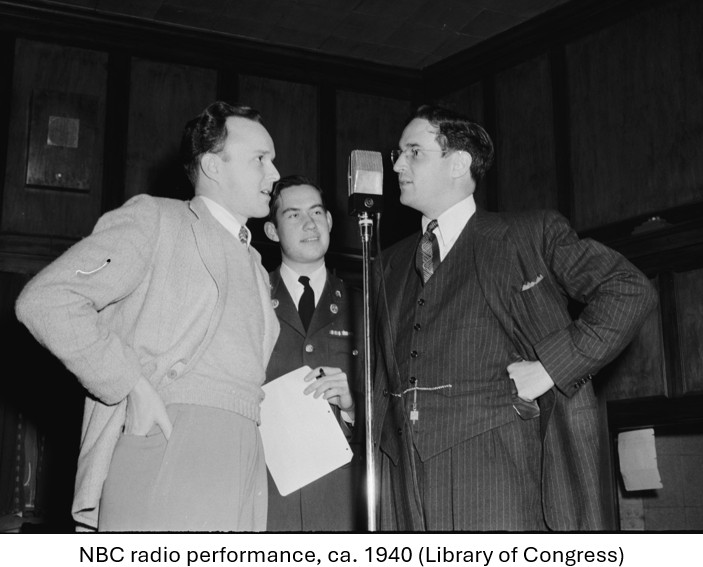
While FCC regulations and licensing decisions were the most consistent sources of federal radio litigation, radio issues reached federal court in many other ways. As mentioned above, the new technology of radio broadcasting intersected with many existing areas of law. While the wide variety of such cases would make it difficult to provide a sweeping account, a few examples demonstrate how courts grappled with the application of legal principles to the unforeseen circumstances radio brought about.
Copyright: In Buck v. Jewell-LaSalle Realty Co. (Supreme Court of the United States, 1931), the LaSalle Hotel in Kansas City, Missouri, owned a radio which was wired to each room in the hotel so that guests could listen via loudspeaker if they desired. The American Society of Composers, Authors and Publishers and one of its members sued the operator of a radio station and the hotel for copyright infringement based on the repeated broadcasting of a copyrighted song which the hotel made available to its guests. The hotel contended that it had only received the broadcast, which did not constitute a “performance” under the Copyright Act of 1909 (which gave a copyright holder the exclusive right to perform a musical composition publicly for profit), and the district court agreed, dismissing the suit. The plaintiffs appealed, upon which the U.S. Court of Appeals for the Eighth Circuit certified to the Supreme Court the question of whether the hotel had engaged in a performance within the meaning of the statute. The Court answered the question in the affirmative, holding that the hotel had not only received but had essentially reproduced the unauthorized broadcast.
Defamation: In Coffey v. Midland Broadcasting Co. (U.S. District Court for the Western District of Missouri, 1934), a Kansas City, Missouri, radio station broadcast a CBS program originating in New York City. During the program, a speaker asserted that the plaintiff was an ex-convict who had spent time in jail. Although the Kansas City station had not produced the program, the station had no prior knowledge that the statement would be made, and the words were spoken too quickly for the station to have prevented them from being broadcast, a federal judge ruled that there was a valid cause of action against the station. “The conclusion seems inescapable,” the court ruled, “that the owner of the station is liable. It is he who broadcasted the defamation. He took the utterance of the speaker which came to him in the form of pulsations in the air. Those waves of air he changed into electrical impulses. Then he threw them out upon the ether knowing they would be caught up by thousands and changed again into sound waves and into a human voice. He intended to do these things. But for what he has done the victim of the defamation never would have been hurt.”
Interstate Commerce: In Station WBT, Inc. v. Poulnot (U.S. District Court for the Eastern District of South Carolina, 1931), the court was faced with a challenge to South Carolina’s Radio Tax Act of 1930, which required owners of radio sets to pay a tax of $1.00 to $2.50 annually. The plaintiff radio station—located in Charlotte, North Carolina, but including nearly the entire state of South Carolina in its broadcast radius—sued, asserting that the tax was an unlawful imposition on its ability to conduct interstate commerce, that is, to communicate with its South Carolina audience. The court determined that the plaintiff had standing to challenge the law because the tax had the potential to severely harm or even destroy its business. “If the state can lay a small tax, it can lay a tax which would be prohibitive,” the court noted. The court agreed with the plaintiff’s contention that all radio communication, “in the present state of the art,” was necessarily interstate. Because regulation of interstate commerce was the exclusive domain of Congress, South Carolina lacked authority to impose the radio tax.
Privacy: In Mau v. Rio Grande Oil, Inc. (U.S. District Court for the Northern District of California, 1939), the plaintiff, a chauffeur, sued a corporation that produced the radio police drama “Calling All Cars.” The program, using the plaintiff’s name without his consent, dramatized an incident in which he was held up by a robber and shot. He claimed that the program caused him mental anguish, leaving him unable to drive and leading to the loss of his job. Following California tort law, as it was bound to do in a diversity of citizenship case, the district court denied the defendant’s motion to dismiss, holding that the plaintiff had a “right to be let alone” that was enforceable in court.
Privacy: In Elmhurst v. Pearson (U.S. Court of Appeals for the District of Columbia Circuit, 1946), prominent Washington, D.C., newspaper columnist and radio commentator Drew Pearson was covering a sedition trial in federal court. During one of his broadcasts, he mentioned a defendant in the case by name, revealing that he was working as a waiter and bartender at a local hotel where he was in a position to overhear conversations among U.S. Department of Justice officials. The individual sued Pearson, among others, for invasion of privacy. After the district court dismissed the case, the U.S. court of appeals held that the plaintiff could not recover damages under these circumstances because “one who becomes an actor in an occurrence of public or general interest must pay the price of publicity through news reports concerning his private life, unless those reports are defamatory. It is also said that even one who unwillingly comes into the public eye because he is involved in a publicized criminal prosecution is subject to the same limitations upon his right of privacy.”
Unfair Competition: In KVOS, Inc. v. Associated Press (Supreme Court of the United States, 1936), a radio station in Bellingham, Washington, was sued for appropriating and disseminating news gathered by newspapers that were members of the Associated Press (AP). The station was “pirating” news by acquiring copies of several area newspapers each day and broadcasting the information therein, either verbatim or with slight changes in wording. This news was often broadcast before the papers reached many of their subscribers. “This practice,” the Court concluded, “constitutes unfair competition with the [AP]; wrongfully deprives the [AP] of the benefit of its labors and expenditures; similarly injures [the AP’s] members; and prejudices the [AP] with its members.” (Despite this finding, the case was dismissed on a jurisdictional issue.)
Unfair Competition: In Pittsburgh Athletic Co. v. KQV Broadcasting, Co. (U.S. District Court for the Western District of Pennsylvania, 1938), radio station KQV leased a piece of property close to Forbes Field, where the Pittsburgh Pirates played. From this location, the field could be seen over the fences, and KQV paid observers to watch the games and provide accounts of the action, which it would then broadcast. The district court issued an injunction ordering KQV to cease this practice on the grounds that it had engaged in unfair competition and intruded on the Pirates’ property rights. The right to broadcast the games, the court ruled, belonged exclusively to the Pirates and any entities to whom they sold those rights. The court concluded that “the Pittsburgh Athletic Company, by reason of its creation of the game, its control of the park, and its restriction of the dissemination of news therefrom, has a property right in such news, and the right to control the use thereof for a reasonable time following the games.” Since the Pittsburgh Athletic Co. case, courts have continued to recognize that professional sports teams have a property right in their games.
This spotlight, which covers only the early history of commercial radio, has provided a glimpse at some of the issues faced by the federal courts as they dealt with a new social, cultural, and technological phenomenon. It has, of course, barely scratched the surface of the rich history of telecommunications law, an area that has grown vastly more complicated and challenging as technology has progressed and federal regulations have multiplied. Today, the federal courts face a host of legal issues related to radio, cable television, and the internet that would have been largely impossible to imagine when KDKA made its election night broadcast in 1920.
[1] While the overwhelming majority of sources (including the website of the Federal Communications Commission) cite KDKA as the first commercial radio station, this claim has been disputed by some radio experts.
[2] While the Constitution gave Congress authority to regulate interstate commerce, Congress had no such authority over commerce conducted entirely in one state. Congress deemed radio signals, however, always to have the potential to cross state lines or at least to cause interference with signals originating in other states.
[3] The Court of Appeals of the District of Columbia, established in 1893, was renamed the U.S. Court of Appeals for the District of Columbia in 1934. In 1948, Congress changed the name again, to the U.S. Court of Appeals for the District of Columbia Circuit, declaring the District of Columbia to be one of the then eleven judicial circuits.
[4] The 1934 Act granted the Court of Appeals of the District of Columbia exclusive jurisdiction over appeals from FCC orders denying applications for radio station construction permits, radio licenses, and radio license modifications. Appeals from all other FCC orders were to be heard by three-judge district courts according to the procedures outlined in the Urgent Deficiencies Act of 1913 (including direct appeal from a district court to the Supreme Court). In 1950, Congress repealed the three-judge provision for such matters, providing that petitioners could take their cases to the U.S. Court of Appeals for the District of Columbia Circuit or that of their own circuit.
[5] Because radio signals travel farther at night, certain “clear channel” stations were permitted to broadcast at maximum power during evening hours with exclusive use of their frequencies. Other stations were forced off the air at night to prevent interference. Clear channel broadcasting was the only method by which some rural areas of the country were able to receive radio service. The regulation of clear channel radio was a significant source of controversy in the 1930s and 1940s.
Jake Kobrick, Associate Historian
For more information, contact history@fjc.gov
Related FJC Resources:
Court of Appeals of the District of Columbia
The Executive Branch and the Courts: Judicial Review of Executive Agency Actions
Further Reading:
Ashby, A.L. “Legal Aspects of Radio Broadcasting.” Air Law Review 1, no. 3 (July 1930): 331–348.
Brown, Thad D. “Radio Law in the Making.” Journal of Air Law 1, no. 4 (October 1930): 599–612.
Caldwell, Louis G. “The Journal of Radio Law.” Journal of Radio Law 1, no. 1 (April 1931): 44–45.
Coase, R.H. “The Federal Communications Commission.” Journal of Law & Economics 56, no. 4 (November 2013): 879–916.
Donovan, William J. “Origin and Development of Radio Law.” Air Law Review 2, no. 2 (April 1931): 107–129 (part 1).
Donovan, William J. “Origin and Development of Radio Law.” Air Law Review 2, no. 4 (November 1931): 468–478 (part 2).
Douglas, Susan J. Inventing American Broadcasting, 1899–1922. Baltimore: Johns Hopkins University Press, 1989.
Ernst, Daniel R. “The Shallow State: The Federal Communications Commission and the New Deal.” University of Pennsylvania Journal of Law & Public Affairs 4, no. 3 (May 2019): 403–458.
Garay, Ron. “The FCC and the U.S. Court of Appeals: Telecommunications Policy by Judicial Decree.” Journal of Broadcasting 23, no. 3 (Summer 1979): 301–318.
The Journal of Radio Law 1 & 2 (1931–1932).
Kadetsky, Ira, and LeRoy Kahn. “Legal Problems of Radio Broadcasting Contracts.” Air Law Review 11, no. 2 (April 1940): 154–169
Keller, Joseph F. “Federal Control of Defamation by Radio.” Notre Dame Lawyer 12, no. 1 (November 1936): 15–39.
Kennedy, Walter B. “Radio and the Commerce Clause.” Air Law Review 3, no. 1 (January 1932): 16–26.
Kirkpatrick, Bill. “Regulation Before Regulation: The Local-National Struggle for Control of Radio Regulation in the 1920s.” Journal of Radio and Audio Media 18, no. 2 (November 2011): 248–262.
LeDuc, Don R., and Thomas A. McCain. “The Federal Radio Commission in Federal Court: Origins of Broadcast Regulatory Doctrines.” Journal of Broadcasting 14, no. 4 (Fall 1970): 393–410.
Masters, Keith. “The Present Status of Radio Law—A Survey.” John Marshall Law Quarterly 1, no. 2 (March 1936): 211–233.
_____________. “Radio Law.” John Marshall Law Quarterly 4, no. 1 (September 1938): 155–168.
McDonald, Joseph A., and Ira L. Grimshaw. “Radio Defamation.” Air Law Review 9, no. 4 (October 1938): 328–351.
Miller, Neville. “Legal Aspects of the Chain Broadcasting Regulations.” Air Law Review 12, no. 3 (July 1941): 293–298.
Shapiro, Barnet Charles. “The Press, The Radio and the Law.” Air Law Review 6, no. 2 (April 1935): 128–154.
Shipley, Carl L. “Radio and Television Law.” Journal of Broadcasting 1, no. 1 (Winter 1956–1957): 57–69.
Siegel, Seymour N. “Censorship in Radio.” Air Law Review 7, no. 1 (January 1936): 1–24.
Tenhula, Peter A., and Carl R. Frank. “The Untold History of ‘Harmful Interference’ in the Regulation of Radio Frequency Communications.” Colorado Technology Law Journal 23, no. 2 (2025): 291–360.
Warner, Harry P. Radio and Television Rights: A Standard Reference Book on the Law of Copyright, Trade-Marks, and Unfair Competition and the Broadcasting Industry. Albany, N.Y.: Matthew Bender & Co., 1953.
Warner, Harry P. Radio and Television Rights: A Standard Reference Book on the Legal and Regulatory Structure of the Radio Industry. Albany, N.Y.: Matthew Bender & Co., 1948.
This Federal Judicial Center publication was undertaken in furtherance of the Center’s statutory mission to “conduct, coordinate, and encourage programs relating to the history of the judicial branch of the United States government.” While the Center regards the content as responsible and valuable, these materials do not reflect policy or recommendations of the Board of the Federal Judicial Center.